
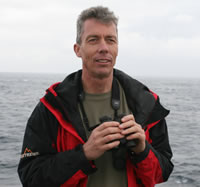
 By Peter Ryan, onboard scientist, expert in general ornithology, seabird-fishery interactions, evolutionary ecology, marine debris, solid waste management, biology of oceanic islands.
Leg 1, Day 1
Day 1 was an atypical day for ACE, travelling through the tropical waters of the Agulhas Current. As a result, we saw quite a few species that are unlikely to be seen again until we return to the Cape in three months. In terms of numbers, most birds were Palearctic migrants* from the North Atlantic. The most abundant Southern Ocean species was the Great-winged Petrel, a rather confused species which breeds at Subantarctic Islands in winter, then spends the summer roasting in tropical waters.
| Cory’s Shearwater* | 178 |
| Great-winged Petrel | 45 |
| Leach’s Storm Petrel* | 24 |
| White-chinned Petrel | 7 |
| Long-tailed Jaeger* | 5 |
| Atlantic Yellow-nosed Albatross | 4 |
| Spectacled Petrel | 3 |
| Black-browed Albatross | 2 |
| Grey Phalarope* | 1 |
| Brown Skua | 1 |
| Shy Albatross | 1 |
| Northern Giant Petrel | 1 |
| Wandering Albatross | + |
| Great Shearwater | + |
Calm seas early on made it easy to spot cetaceans, with five rorquals seen before 9h00 (1 Bryde’s, 1 possible Fin and 3???). But the cetacean highlight came in the late afternoon, in the form of a pod of Gray’s Beaked Whales. Flying fish were abundant, and three large ? Yellowfin Tuna were nice to see. Plastic waste was fairly abundant by Southern Ocean standards: 13 items in 262 km of transects
