
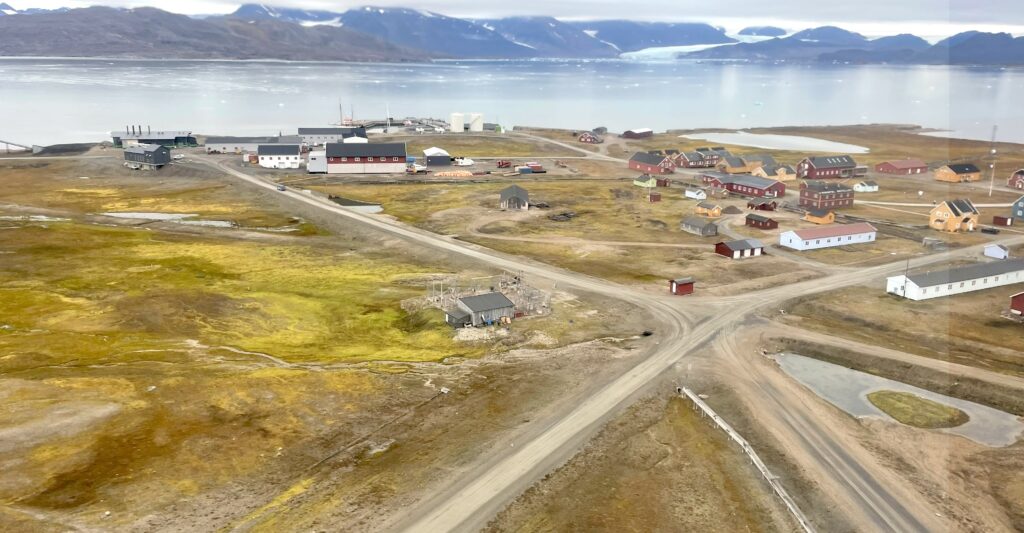
Flying over the Kongsfjorden (Spitsbergen, Svalbard) is always an intense moment. This was my second mission for the project The greening of Arctic lake shores under the effect of climate change: a new hotspot for benthic cyanobacteria, yet every arrival feels new: the Arctic never looks the same twice. By late August, the tundra was already glowing in autumn colours, and the meltwater streams still carried heavy loads of sediment and nutrients into the fjord. It was the perfect season to study algal growth, which had already peaked between late July and early August under the warmth and constant light of the high Arctic summer.
During the mission, I stayed at the Arctic station Dirigibile Italia (CNR) which also provided essential logistical support. Ny-Ålesund is the northernmost permanent research settlement in the world, located at 78.9°N, 11.9°E, hosting about 20 international research stations. Its remoteness, minimal local human impact, and accessibility to both glaciated catchments and pristine freshwater systems make it one of the most important natural laboratories to study the ecological effects of climate change. Here, warming rates are among the fastest on the planet, and the lakes act as sentinels of environmental change.


Left: the Research Station Dirigibile Italia (CNR). Right: the view of Kongsfjorden from the village
© Camilla Capelli, all rights reserved
Outside the village, no one works alone as polar bears regularly roam these landscapes. Our project was therefore carried out together with colleagues from Sapienza University of Rome, who were conducting complementary research in the same catchments.
Fieldwork here is never straightforward. The small lakes selected for our study are scattered across the Brøggerhalvøya peninsula, often near glaciers, and reaching them requires crossing moraines, proglacial streams, and unstable permafrost ground. Normally by August the water levels are lower, but this year the unusually high temperatures have boosted glacial melt. Streams were still swollen and fast-flowing. In some places we relied on the support of a boat of the Norwegian Polar Institute, which allowed us to approach the more remote sites directly from the fjord.


Left: crossing Bayelva River to reach sampling sites © E. Calizza, all rights reserved. Right: small lakes next to Midtre Lovénbreen © A. Canova, all rights reserved
Once at the lakes, we measured temperature, dissolved oxygen, pH, conductivity, and algal pigments with a multiparametric probe. In the littoral zones, we collected submersible cobbles and carefully scraped off the benthic biofilm – a dense layer of cyanobacteria and microalgae. In some lakes, bright mats of filamentous green algae were strikingly abundant, forming the so-called “greening” phenomenon. Increasingly frequent even in nutrient-poor waters, these blooms can harbour cyanobacterial communities quite different from those typically found on cobbles. To capture this contrast, we also sampled the green algal mats directly.


Left: scraping off cobbles to collect benthic cyanobacteria © E. Calizza, all rights reserved. Right: dense mat of filamentous green algae in a lake fed by Vestre Brøggerbreen © C. Capelli, all rights reserved
This comparison will help us address a key question: Could climate-driven greening favor toxic cyanobacterial taxa at the expense of the “normal” benthic community? Current data suggest cyanotoxin production in the Arctic is low and taxonomic diversity limited. But with rising temperatures, shifting nutrient dynamics, and longer ice-free seasons, toxic species might find new opportunities here, with potentially profound consequences for Arctic freshwater ecosystems and animals that depend on them.
After long hours in the field, carrying heavy packs across rugged terrain, we returned each evening to the base to process samples in the lab. The Kings Bay Terrestrial Laboratory equipped with optical microscopes allowed for preliminary analyses of the cyanobacterial community. More advanced metagenomic and metabolomic analyses require specialised equipment unavailable in Ny-Ålesund, so samples were carefully filtered, preserved, and prepared for shipment. They will leave the Arctic aboard the cargo ship in autumn, and we will have to wait out the polar night before having a look at the first results.
Field days are precious, and the weather often dictates the pace. Low clouds, winds or poor visibility increase the risk of unexpected polar bear encounters, sometimes forcing us to suspend activity. But when conditions improve, the team takes full advantage of the endless light, working long into the evening to complete the demanding sampling programme. This time, the weather was on our side, and we managed to sample every lake on the list.
With that, the 2025 campaign of the project draws to a close. The samples are on their way south, and soon the data will begin to reveal whether climate change is shaping the community of Arctic cyanobacteria. Until then, I carry with me the memory of colourful lakes and long days of science, and I express my gratitude to the Swiss Polar Institute and the Arctic station Dirigibile Italia for their support on this project.
Camilla Capelli is Senior Researcher in Aquatic Ecology, Head of Freshwater Ecology, Institute of Earth Sciences, at the University of Applied Sciences and Arts of Southern Switzerland (SUPSI). Her fieldtrip took place in summer 2025 with financial support of an SPI Exploratory Grant.
Header image: © Camilla Capelli, all rights reserved